Business Data Owner
Decides who the data product serves and the value it should create, then sets fit-for-purpose risk and quality thresholds within legal, regulatory, enterprise-risk, and policy guardrails—and remains accountable for the outcome.
The Data Preparation Layer
This page uses a food supply chain analogy to explain why trusted data platforms need a preparation layer between source systems and data consumers.
Different data sources are like ingredients from different origins. They come with different owners, formats, assumptions, freshness, and quality.
A trusted data platform works like a professional kitchen. It prepares ingredients once, with quality checks, labels, identity, storage rules, provenance, and governance, so many dishes can be made without repeating the same preparation work.
The semantic layer and ontology act like recipes and cooking logic. They explain what ingredients mean, how they can be combined, and what rules apply.
AI, applications, analytics, and simulations should not need to search every source system for raw ingredients. They consume prepared, governed data products to create trusted decisions and business outcomes.
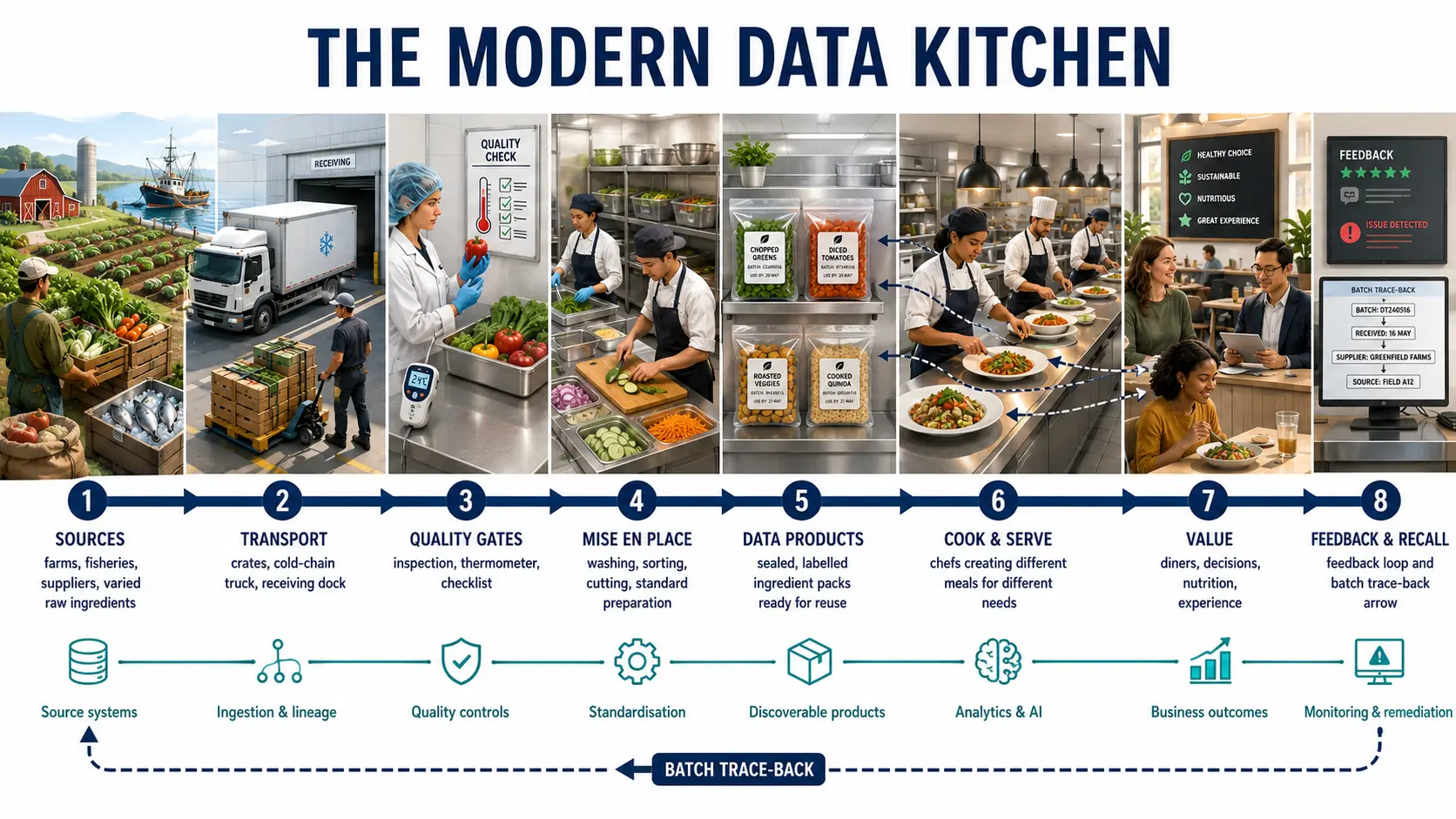
Eight-stage mapping
The visual is a summary. This stage-by-stage mapping carries the same information in a readable, reusable form on every screen size.
Farms, fisheries, suppliers, and varied raw ingredients map to heterogeneous systems, owners, formats, and data quality.
Crates, cold-chain transport, and receiving map to controlled movement with origin, handoff, and provenance recorded.
Inspection, temperature checks, and acceptance criteria map to validation, rejection, and measurable fitness checks.
Washing, sorting, cutting, and standard preparation map to cleaning, classification, identity resolution, and common formats.
Sealed and labelled ingredient packs map to reusable assets with ownership, metadata, quality expectations, and consumption interfaces.
Chefs combine prepared ingredients for different needs, as applications, analytics, and AI use governed products through purpose-specific logic.
Nutrition and customer experience map to decisions, operational improvement, risk reduction, and measurable value.
Consumer feedback and batch trace-back map to observability, issue management, impact analysis, correction, and continuous improvement.
Core principle
Separate data production from data consumption. Source systems should not become places every application, analyst, or AI agent has to search independently.
The platform layer turns raw and semi-prepared data into governed data products, semantic definitions, knowledge assets, and decision-ready outputs.
Source systems and data pipelines are not the right place for every application, dashboard, or AI agent to prepare its own data. A trusted data platform works like a modern kitchen: it receives raw and semi-prepared ingredients, checks quality, records provenance, standardises preparation, applies governance controls, and serves reusable data products to many consumers.
Ownership and accountability
Data products are like food products: the business decides who they serve and what value they create, then sets fit-for-purpose risk and quality thresholds within legal, regulatory, enterprise-risk, and policy guardrails—and remains accountable for the result. Data platform teams operate the kitchen and technical controls. Governance teams provide standards, minimum controls, measures, and independent challenge. Neither becomes the business owner.
Decides who the data product serves and the value it should create, then sets fit-for-purpose risk and quality thresholds within legal, regulatory, enterprise-risk, and policy guardrails—and remains accountable for the outcome.
Maintains definitions, rules, quality issues, and day-to-day coordination across producers, owners, and consumers.
Operates the platform, storage, processing, access controls, lineage, reliability, and technical quality controls.
Provides the framework, standards, minimum controls, measures, and independent challenge needed to govern data consistently.
Show whether data is genuinely discoverable, trustworthy, understandable, and usable—and feed issues back into improvement and trace-back.
A technical team can be accountable for storage, processing, access controls, lineage, and reliability without owning the business purpose, value, risk appetite, or fitness decision. Technical custody and business ownership are different responsibilities.
Reality Capture as Food Preparation
Before food reaches a kitchen, it has already gone through a supply chain: harvesting, catching, collecting, cleaning, cutting, packaging, transporting, storing, and labelling.
Data has a similar lifecycle. Reality is captured through sensors, GIS, BIM, LiDAR, imagery, documents, surveys, operational systems, and human records. Each capture method creates a different digital representation, with its own assumptions, precision, freshness, coverage, and intended use.
For spatial and digital twin platforms, this is especially important. The same real-world object may appear as a map feature, BIM element, point cloud, sensor record, document reference, scene object, or knowledge graph node. Governance connects these representations back to the same reality through identity, metadata, lineage, quality, semantic mapping, and observability.
Lifecycle analogy
The analogy is strongest when it follows the full lifecycle. Source systems provide raw ingredients; capture and preprocessing create prepared representations; the middle platform governs them; semantic logic explains how to combine them; AI and applications consume trusted outputs.
Different systems produce data with different owners, formats, assumptions, freshness, and quality.
Capture and HandlingSource ProcessingData is captured, transformed, packaged, and moved before it reaches the platform. Those upstream assumptions need to be understood.
Market and StorageData InventoryThe platform needs to know what data exists, where it came from, who owns it, and whether it is fit for use.
Professional KitchenData Middle PlatformPrepare trusted data once so many consumers can reuse it safely.
PreparationData Quality, Metadata, IdentityClean, classify, identify, validate, and trace data before it is reused.
Recipes and Cooking LogicSemantic Layer and OntologyDefine shared meaning, relationships, rules, and constraints for consistent reuse.
Meals and NutritionDecisions and OutcomesAI, applications, analytics, and simulations consume trusted data to create decision value.
Teaching scenario
Data Kitchen is not a food framework. Food is a teaching model for explaining why repeatable decisions need standardisation, governance, supply-chain visibility, quality controls, metadata, and shared meaning.
A McDonald's-style operating model is useful because the product looks simple to the customer, but behind it sits a governed system of suppliers, recipes, labels, preparation standards, quality checks, version control, and impact analysis.
The physical world before it becomes a product, record, label, or system entry.
Different systems represent the same real-world ingredients in different ways.
The same item or batch needs persistent identity across systems and handoffs.
Data becomes reusable only after preparation, quality checks, metadata, and control.
Business meaning is defined independently from individual source ingredients.
Relationships connect products, ingredients, suppliers, standards, metadata, and decisions.
Trusted data supports impact analysis, operational response, and business decisions.
They are made from well-prepared, trusted recipes. Ingredients are data. Recipes are semantic definitions, governance rules, and business logic. Meals are decision assets.
One ingredient set, many recipes
A simple chain burger may look like one product to the customer, but behind it sits a governed system of suppliers, ingredients, preparation standards, labels, quality checks, recipe versions, and regional variations.
Data products work the same way. A dashboard metric, AI answer, digital twin view, risk score, or decision recommendation may use overlapping prepared data ingredients, but each end use needs its own recipe: definitions, quality thresholds, relationships, rules, context, and governance controls.
The semantic layer and ontology provide that governed, reusable meaning. They explain what the data means, how it can be combined, which rules apply, and how changes affect downstream decisions.
Universal teaching model
The point is not the food example itself. The point is to give business, data, architecture, operations, and AI teams a shared language for why preparation, governance, semantics, and feedback loops matter.
Data governance, semantic layer, metadata, quality, lineage, standardisation
Reality mapping, identity, operational events, service dependencies
Source-to-scene, spatial relationships, scene governance, knowledge graph
Master data, lineage, controls, regulatory evidence, decision accountability
Data products, event streams, automation, quality, operational feedback
Consulting question
The answer reveals whether the organisation has an AI-ready data platform or a growing collection of fragile point solutions. Prepared data products are governed, reusable data assets that have already been cleaned, described, identified, quality-checked, linked, and made ready for repeated consumption.
Where Data Is Different from Food
Food is consumed when it is used. Data can be reused, copied, linked, enriched, and improved. With the right feedback loops, data quality can increase over time as issues are detected, definitions are clarified, lineage is strengthened, and semantic mappings are improved.
Food can often be cut into smaller pieces. Data granularity is limited by how reality was captured and how source systems recorded it. A building-level record cannot automatically become a trusted room-level or component-level record without new evidence, inference, or modelling.
Data supply chains can also become longer than food supply chains: source systems, transformations, matching rules, semantic mappings, knowledge graphs, vector indexes, AI agents, decisions, and feedback loops. This makes lineage, provenance, versioning, ownership, observability, semantic controls, and decision accountability essential.
Explore next
Explains the operating model for curating once and reusing many times across AI, applications, and decisions.